
The Egyptian Museum in Cairo

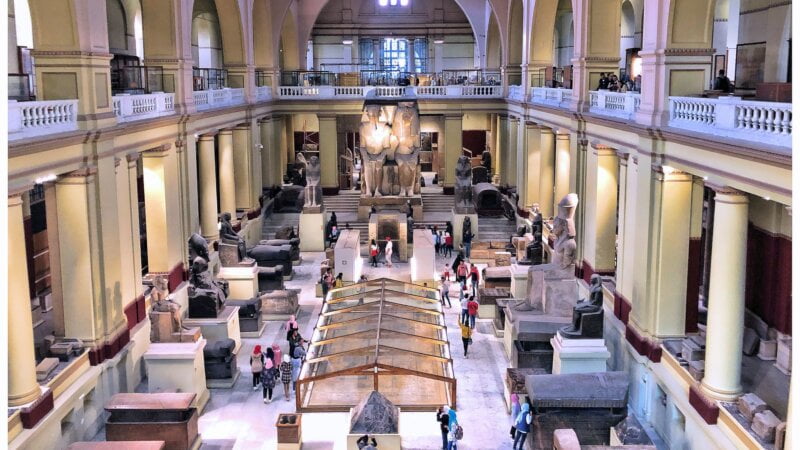


The idea of a museum for Egyptian antiquities in Egypt goes back to Muhammad Ali Pasha, who was viceroy of Egypt from 1805 to 1848. Attempting to put an end to the export of antiquities, he issued a decree on the 15th of August 1835, which resulted in the first Egyptian museum for antiquities in Cairo. Housed in a building near El-Ezbekia Garden, the display was designed by Hakikan Effendi, and the collection was managed by Youssef Diaa Effendi. At the same time, Sheikh Rifa’a al-Tahtawi, who was responsible for the excavation and conservation of Egyptian monuments, also ordered that no further excavations be undertaken without his permission. He announced that the export of artefacts from Egypt was strictly forbidden, and that all finds were to be transported to the El-Ezbekia Museum.
In 1851, under the reign of Abbas I, the entire collection was transferred from El-Ezbekia to one of the halls within the Citadel of Salah El-Din (Saladin), where it was accessible only to private visitors. However, in 1854, most of the objects were offered to Austria’s heir to the throne, Archduke Maximilian, who had shown great interest in them during his visit to Egypt. They now represent a major part of the Egyptian collection in the Kunsthistorisches Museum in Vienna.
The Egyptian Museum of Antiquities contains many important pieces of ancient Egyptian history. It houses the world’s largest collection of Pharaonic antiquities. The Egyptian government established the museum built in 1835 near the Ezbekieh Garden and later moved to the Cairo Citadel. In 1855, Archduke Maximilian of Austria was given all of the artifacts by the Egyptian government; these are now in the Kunsthistorisches Museum, Vienna.
A new museum was established at Boulaq in 1858 in a former warehouse, following the foundation of the new Antiquities Department under the direction of Auguste Mariette. The building lay on the bank of the Nile River, and in 1878 it suffered significant damage due to the flooding of the Nile River. In 1891, the collections were moved to a former royal palace, in the Giza district of Cairo. They remained there until 1902 when they were moved, for the last time, to the current museum in Tahrir Square, built by the Italian company of Giuseppe Garozzo and Francesco Zaffrani to a design by the French architect, Marcel Dourgnon.
In 2004, the museum appointed Wafaa El Saddik as the first female director general.
During the Egyptian Revolution of 2011, the museum was broken into, and two mummies were destroyed. Several artifacts were also shown to have been damaged and around 50 objects were lost. Since then, 25 objects have been found. Those that were restored were put on display in September 2013 in an exhibition entitled Damaged and Restored. Among the displayed artifacts are two statues of King Tutankhamun made of cedar wood and covered with gold, a statue of King Akhenaten, ushabti statues that belonged to the Nubian kings, a mummy of a child and a small polychrome glass vase.