
Alnwick Castle



The second largest inhabited castle in the UK, Alnwick has served as a military outpost, a teaching college, a refuge for evacuees, a film set, and not least as a family home. Delve deeper into this extraordinary history and travel through the centuries of this living, evolving castle.
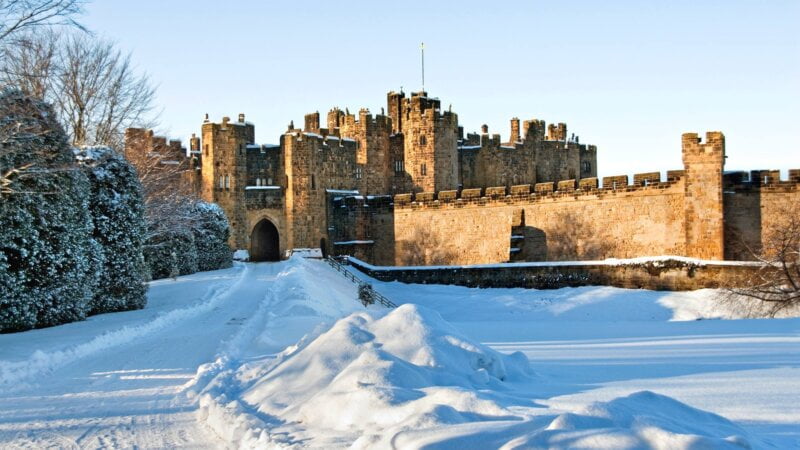
In 1309, Henry Percy, great-great grandfather of Hotspur, purchased a typical Norman-style castle of motte and bailey form. In the following 40 years he and his son converted it into a mighty border fortress. They added towers and guerites around its curtain walls with a strong gatehouse at the entrance and a concealed postern gate to the rear. The gateway to the keep was strengthened with the addition of two massive octagonal towers.
Stone figures were added to the tops of the battlements, as was fashionable at that time, either for ornament, or to confuse attackers. This was a medieval device that the 1st Duchess was to copy to excess in the more fanciful mid-18th century castle restoration.
Early in the 16th century, the castle was assessed and written off in defensive terms as not liable to abide the force of any shot or to hold out any time if it should be assaulted. In 1567, the 7th Earl employed George Clarkson to survey the castle and his northern estates. His detailed account, together with the plans drawn by Treswell in 1608, enable us to be quite accurate about how the castle looked and what the buildings were used for during this period.
Clarkson also describes the condition of the buildings, mentioning that the Ravine Tower was “so rente that it is mooche like to fall”, as indeed it did later in the 17th century. Clarkson describes the corner tower in the inner bailey as having no back to it, being two storeys and only as high as the battlements, and being used for storing hay.
By 1608, Treswell shows it as three storeys high with a stone back. Perhaps this reflects the creation of the Record Tower between 1567 and 1608.
During the 17th century, the castle fell into disrepair, both through neglect because the Percy family was mainly resident in the south, and through damages done in wartime. The best visual evidence for the appearance of the castle at this date is a painting by Peter Hartover (fl.1674-1690), which depicts the ruinous chapel and trees growing out of the stonework.
Transforming the castle from a decaying garrison fortress to a palace was conceived in a high gothick style to the designs of the architects Daniel Garrett, James Paine and Robert Adam in the 1760s. Work on the parklands carried on in tandem. Weirs were built on the River Aln to slow the water flow with the effect of enhancing the landscape and providing a reflective surface for the newly restored castle.
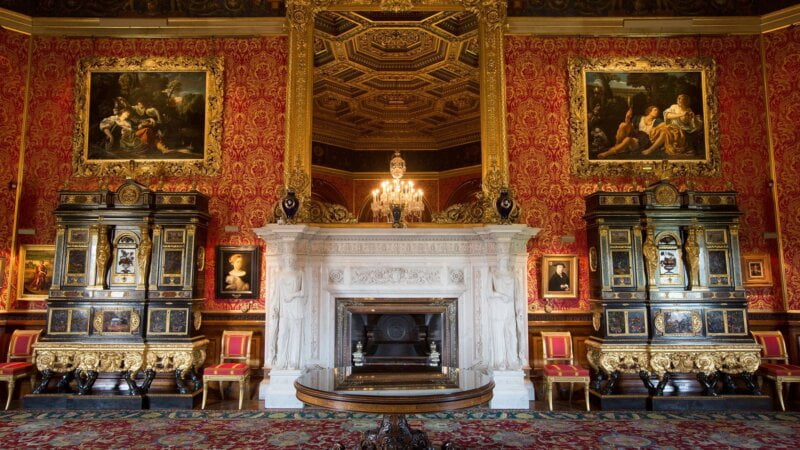
The 4th Duke disliked the ‘fairytale gothick’ style and inconvenience of the castle created by the restoration undertaken a century previously. He employed the architect Anthony Salvin to restore a more authentic medieval border fortress appearance to the exterior. For the state apartments, however, Algernon chose the lavish style of an Italianate palazzo. Improvements were made across the castle site exploiting new technologies of the Victorian age.
By the time Hugh Percy entered the dukedom in 1940, the large team of live-in domestic servants he had known as a boy was no longer in existence. This left vast areas of the castle unused and unoccupied. These provided facilities, first for the accommodation of Alnwick Teacher Training College, and then, from 1981, for St Cloud State University students from Minnesota in the United States.
The Duke and his family share their home with Estates Office staff, American students from St Cloud State University residential programme and the general public. Recent years have witnessed an extensive programme of conservation, repair and refurbishment to the fabric of the building, both exterior and interior. Roof leads have been replaced; essential masonry repair and re-pointing has been undertaken, as well as conservation work and refurbishment of the interiors. Such works both preserve the castle and continue its development.
Alnwick Castle contains an extraordinary and unusual survival in the 21st century of a collection and archive remaining in a property owned by the same family for over 700 years.
A small professional team manages the Northumberland Collection and Archive; no public funding is received towards its conservation and preservation.
Alnwick Castle most recently featured in Transformers: The Last Knight, and as the magnificent Brancaster Castle in Downton Abbey’s 2015 and 2016 Christmas specials. Having already featured as Hogwarts in the first two Harry Potter films, as well as appearing in Elizabeth and Robin Hood: Prince of Thieves, among others, the castle is no stranger to film crews!