
Mir Castle Complex

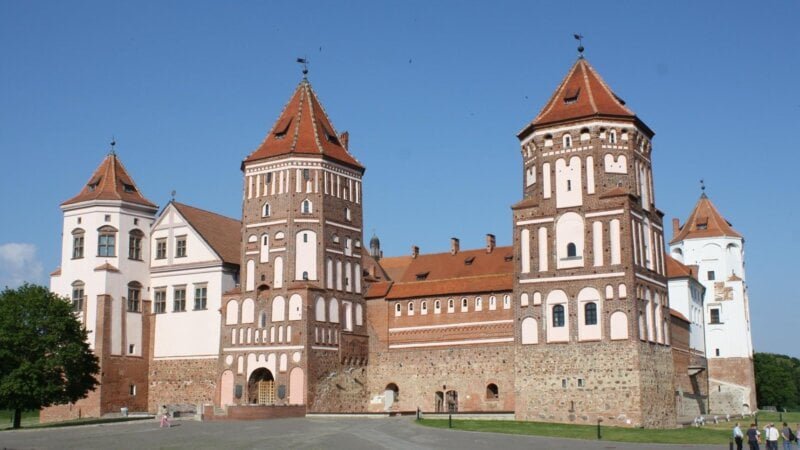
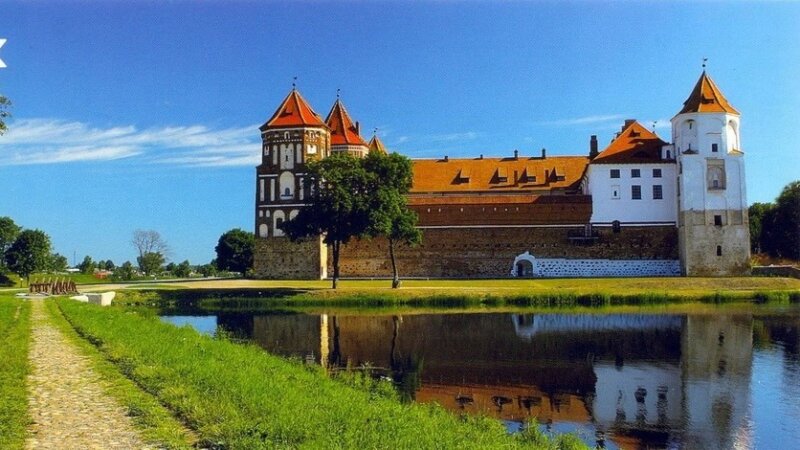
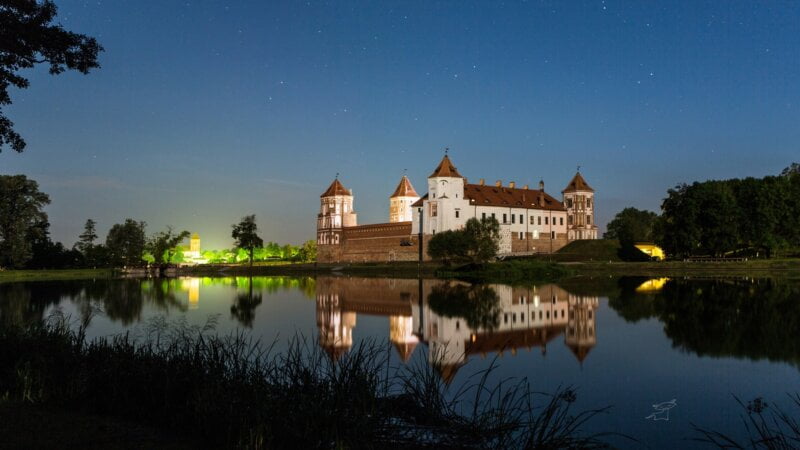
Mir Castle Complex of XVI–XX centuries in a small town Mir is a historical and cultural value of national importance and UNESCO World Heritage. For the first time Мir was mentioned in 1434 when it becomes a private estate of Senko Gedygoldovich. According to his will in 1451 Mir passes to Anna Butrimovna, his foster daughter. In 1476 Anna gives Mir as possession for life to Senko’s wife Milokhna, and after her death – to her cousin Yury Ilinich, who started building the castle.
The owner of Mir had strong reasons for erecting such a mighty fortification building. At the beginning of the 16th century Crimean Tatars attacked these lands more frequently. Unstable political situation was worsened by the hostility among the feudal groups inside the country.
In particular, the Iliniches were in confrontation with a very powerful and influential prince Mikhail Glinsky. Nevertheless there was one more important reason for building the castle. Yury Ilinich aspired to get a title of a count of the Holy Roman Empire and one of the necessary conditions for this was having a stone castle. This was the first case when such a mighty fortress was built on the territory of the Grand Duchy of Lithuania by a private owner.
At the first stage of construction five towers were erected. They were connected with walls whose thickness at the foundation was up to three meters. All the towers were planned as independent centers of resistance. They were erected in such a way that it was convenient to deliver flanking fire along the walls and to hit an approaching target. Each tower was about 25 meters in height and had five fighting storeys with loopholes and a complex system of inner passages. The builders used three-layer laying – the inner and outer parts of the walls were made of brick and huge stones and the space between them was filled with small stones and broken bricks.
Although all the towers may seem to have the same construction, each of them has its own architectural peculiarities. The lower tetrahedral part of the towers becomes octahedral at different heights slightly losing in its size. The decoration of the towers’ fronts also varies.
The owners of the castle – the Iliniches – didn’t manage to accomplish the construction. Their family died away within forty years. Shortly before his decease Yury Ilinich Junior, the grandson of the founder, bequeathed Mir County to his cousin Prince Mikolaj Krzysztof Radziwill nicknamed the Orphan. Over the next three centuries the castle was owned by the representatives of a powerful dynasty of the Radziwills.
Having acquired the ownership rights for Mir County in 1569, Prince Mikolaj Krzysztof Radziwill nicknamed the Orphan decided to make the castle one of his residences. At his behest three-storey living palaces were erected along the northern and eastern walls of the castle, the three adjacent towers were rebuilt and a barbican at the Entrance tower appeared. Earth mounds with bastions at the angles were raised around the castle. A fosse filled with water was dug behind the earth mounds.
At the end of the 16th century the bastion fortifications lost their importance. The reasons why Mikolaj Krzysztof Radziwill decided to stop further modernization of Mir Castle are still unknown. After the construction of a mighty castle in Nesvizh at the end of the 16th – beginning of the 17th centuries the princely residence moved there. Mir Castle became something like a country seat. The walls of the palace and towers were plastered and painted pink. The window and door portals were made from grey sandstone imported from Galicia. The basement and the ground floor of the palace incorporated housekeeping facilities and storerooms; the administration of Mir County, a municipal court and a clerical office were located on the first floor, the second floor was intended for the owners whose living accommodation was situated there.
At the beginning of the 17th century an Italian garden was laid out near the castle.
After these massive transformations the castle had seen a peaceful lifetime which was broken off by a war between the Polish-Lithuanian Commonwealth and the Tsardom of Muscovy. In 1655 Mir Castle was ravaged by Cossacks of Ivan Zolotorenro and Russian troops of voivode Aleksey Trubetskoy.
The castle fell into oblivion for around 30 years. And it wasn’t until 1680 that Katarzyna (Ekaterina) Radziwill from the Sobiesky family initiated restoration works in Mir Castle after her husband Mikhail Kazimierz had died. But the Great Northern War of 1700–1721 suspended her undertakings for many years. In April 1706 Mir was invaded by the troops of Charles XII. The whole township with the castle was on fire, everything that had been restored was destroyed.
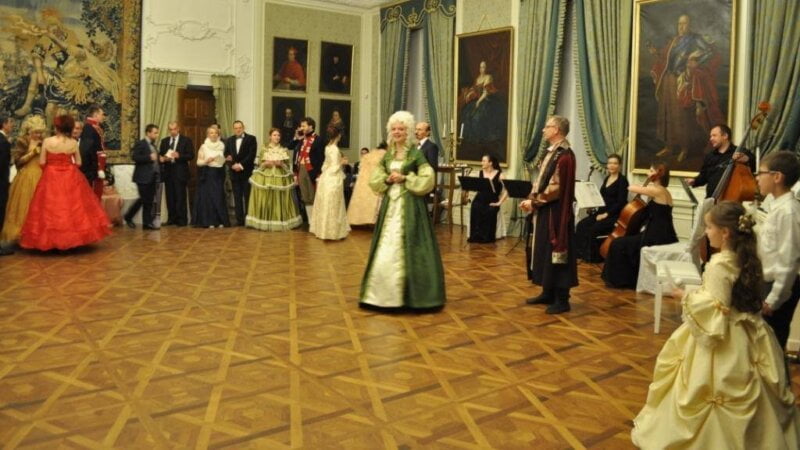
The castle regained its former grandeur thanks to a new owner – Prince Mikhail Kazimierz Radziwill nicknamed the Rybonka. The chambers of the fourth princely floor were replanned. The rooms of a similar layout, predominantly of a square type, were replaced by a suite of halls of different sizes. For this purpose the internal partitions were rearranged, the stairs line was changed. The Stateroom as well as the Portrait and Dance Halls were decorated with oak parquet floors, gilded ceilings, superb furniture, tapestry, paintings, chinaware and delftware. A lot of valuable and refined objects were produced at the Radziwills’ manufactories.
In 1891 Mir estate and the castle were purchased by a Cossack chieftain of the Don Troops, Prince Nikolay Svyatopolk-Mirsky. Apparently, the prince was attracted by the name of the estate. When he came to Mir he immediately got down to work with great enthusiasm. An alcohol plant and a two-storey palace, which became the main composition center of the palatial and park complex, were built opposite the castle. A water reservoir with islands was made in front of the new palace instead of five ponds and a cut down garden.
In 1922 Nikolay’s son Mikhail started to restore Mir Castle. The works had lasted for 16 years. During this period a part of the Eastern palace and two southern towers were restored.
During the Great Patriotic War from May to August 1942 the castle served as a ghetto where Hitler’s forces imprisoned around 800 local Jews. In summer the prisoners organized a resistance group. On August 9, 1942 over 250 Jews managed to escape. Three days later those who stayed in ghetto were shot by fascists in the forest not far from Mir.
After the liberation of Belarus in July 1944 dwellers of Mir whose houses had been ruined found refuge in the castle. The last family moved out from the castle in 1962.
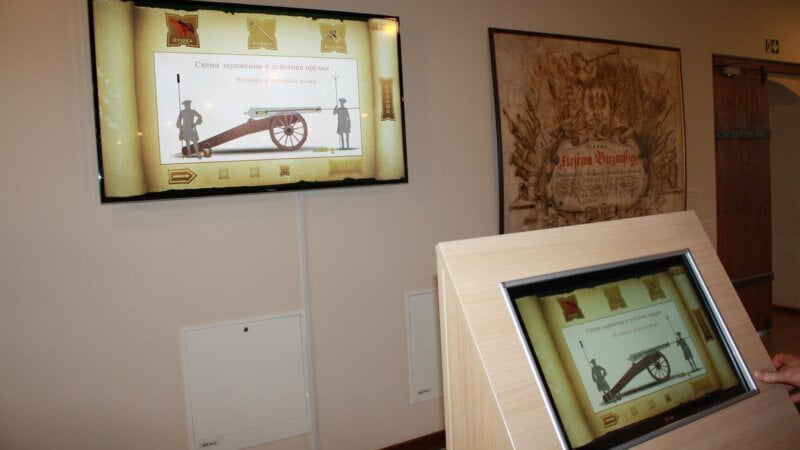
The restoration works in Mir Castle began only in 1983. In 2000 it was listed by UNESCO as a World Heritage Site. On December 16, 2010 an official opening of Mir Castle took place.
Share this listing...
