
Bronzi di Riace


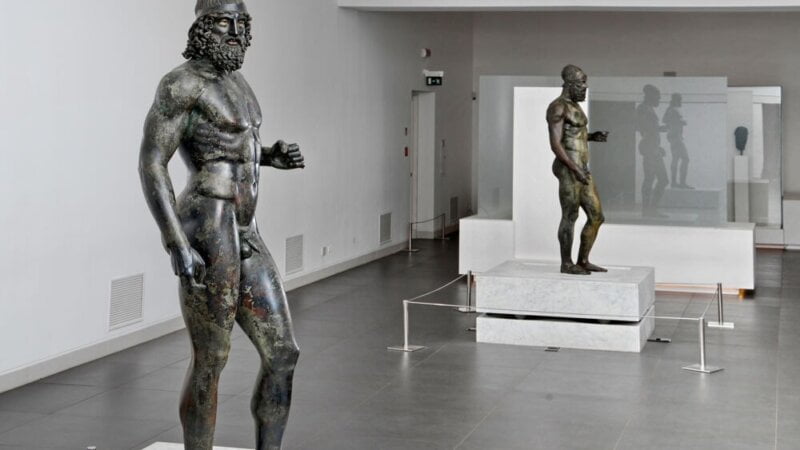


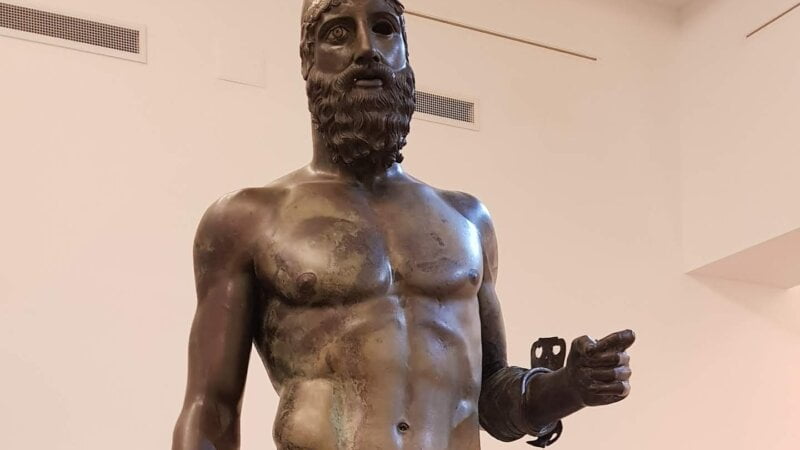
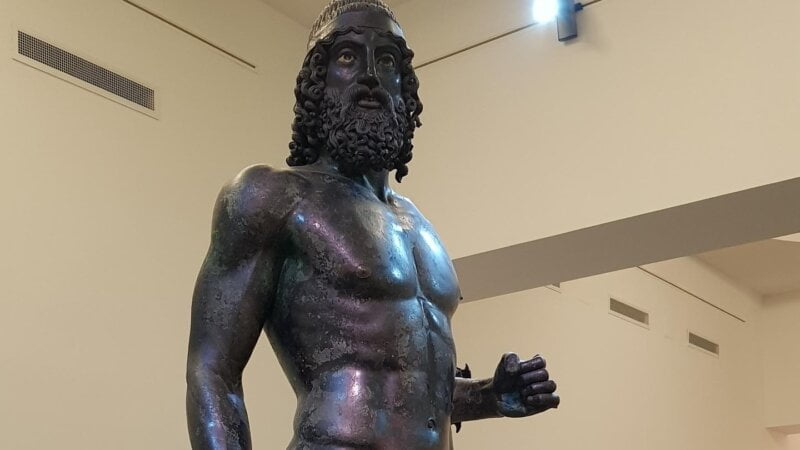
La località di ritrovamento, posta presso un porto mai studiato scientificamente, ma che sembra essere attivo già dall’epoca greca, è altamente significativa. La sua funzione di porto è resa certa dalla presenza della Torre di Casamona, di epoca angioina, anche se datata erroneamente al XVI sec., la cui funzione era quella di proteggere l’approdo e fungere da luogo di esazione delle tasse. Il ritrovamento delle due statue nei pressi del porto avvalora le teorie che mettono in relazione la presenza a Riace dei due Bronzi con il loro trasporto da o verso Roma. Altri particolari, come la presenza della ceramica per proteggere l’integrità della Statua A, sembrano attestare che le due opere erano in viaggio per essere esposte in un altro luogo. Le due statue sono di bronzo, dallo spessore molto tenue, tranne alcuni particolari in argento, in calcite e in rame. Sono in argento i denti della Statua A. In rame sono stati realizzati i capezzoli, le labbra e le ciglia di entrambe le statue, oltre che le tracce di una cuffia sulla testa del Bronzo B. In calcite bianca è la sclera degli occhi, le cui iridi erano in pasta di vetro, mentre la caruncola lacrimale è di una pietra di colore rosa. Le due statue sono state certamente eseguite ad Argo, nel Peloponneso e raffigurano due opliti, anzi un oplita (Bronzo A) e un re guerriero (Bronzo B). Oggi i due bronzi si trovano al Museo Archeologico di Reggio Calabria, in ambiente protetto e meritano assolutamente una visita.
The Bronzes were found in 1972, in an exceptional state of conservation, on the bottom of the Ionian Sea, near the town of Riace Marina, by a passionate diver during a dive about 200 m from the coast and at a depth of 8 m. In the locality of Porto Forticchio di Riace Marina, two bronze statues were found, apparently without any contemporary finds in the surroundings. Their recovery was carried out with an embarrassing lightness and with inappropriate means, to the point that a large piece of late antique ceramic was “forgotten” on the beach, placed between the right forearm and the chest of Bronze A to prevent the arm itself could be damaged during transport.
After the recovery, the statues were sent for a first restoration, which was carried out between 1975 and 1980 in Florence. There were two objectives of the intervention: cleaning and conservation of the external surfaces; attempt to empty the fusion earth placed inside the statues. The removal of the fusion earth was carried out in the restoration laboratory located in the Reggio Museum in the years 1992-1995, and finally concluded in the last restoration between the years 2010 and 2013, carried out at the headquarters of the Regional Council of Calabria, in Palazzo Bell.
The two statues, called “A” and “B”, and renamed in Reggio as “the young” and “the old”, are respectively 1.98 and 1.97 m high, and their weight, originally 400 kg, now it has decreased to about 160 kg, by virtue of the removal of the melt.
The place of discovery, located near a port that has never been scientifically studied, but which seems to have been active since the Greek era, is highly significant. Its function as a port is confirmed by the presence of the Casamona Tower, dating back to the Angevin era, even if erroneously dated to the 16th century, whose function was to protect the landing place and act as a place for tax collection. The discovery of the two statues near the port confirms the theories that relate the presence of the two Bronzes in Riace with their transport to or from Rome. Other details, such as the presence of ceramics to protect the integrity of Statue A, seem to attest that the two works were on their way to be exhibited in another place. The two statues are of very thin bronze, except for some details in silver, calcite and copper. The teeth of Statue A are in silver. The nipples, lips and eyelashes of both statues were made in copper, as well as the traces of a cap on the head of Bronze B. In white calcite is the sclera of the eyes, the whose irises were in glass paste, while the lacrimal caruncle is of a pink colored stone. The two statues were certainly made in Argos, in the Peloponnese and depict two hoplites, indeed a hoplite (Bronze A) and a warrior king (Bronze B). Today the two bronzes are in the Archaeological Museum of Reggio Calabria, in a protected environment and are absolutely worth a visit.